Is there such a thing as perfect time/place/manner for conflict resolution?

Faerie Targaryen

New member
Hi, guys!

I’ve really been enjoying perusing the resources on here; some comforting, all eye-opening. It’s all stuff I could never find on social media or on the first page of google and I am so so grateful for this wonderful well I’ve fallen down filled with treasure.

However, I have a pressing need. I would like to know that I’m not doing a horrible job with bringing up hard stuff with my partner – or that if I am, I would love to know how to do better. I’m pretty much scared of his reactions to when I have something hard to say. He specifically doesn't do well with feeling like he’s done something wrong and hurt me, and we kind of get wrapped up in that, rather than conflict resolution, as was my initial aim of bringing stuff up.

How do I reassure him in moments like this? How do I say ‘something makes me concerned and I want to work through it with you’ in a way that perhaps bypasses his triggers of guilt? Should I on the lookout for the right moment?

I’ve tried searching the forum on my own, but I don't seem to know the right keywords. (I also keep getting sidetracked when I find some other external link that looks even slightly interesting to me.) At this rate, I’ll be searching forever. And to be honest, I pretty much need the knowledge… yesterday😹 for my own sanity.

Can someone please point me in the right direction? Thank you.
 
Unless it is some kind of emergency, I prefer dealing with conflict resolution conversations after work Friday, because then there's the weekend to recover from whatever. You don't have to get up to go to work the next morning.

However, I have a pressing need. I would like to know that I’m not doing a horrible job with bringing up hard stuff with my partner – or that if I am, I would love to know how to do better.

You could read the Non-Violent Communication (NVC) materials by Marshall Rosenberg. There are many books, but I like "Living Non-Violent Communication."

The PDF of the general process can be found here:

https://www.nonviolentcommunication.com/learn-nonviolent-communication/4-part-nvc/

I'm going to ask some things. I'm not trying to be rude, mean, or make any assumptions, just trying to understand what it is you have on your hands over there.

I’m pretty much scared of his reactions to when I have something hard to say.

How does he behave when he responds or reacts that makes it scary for you? Shouting? Hitting things? Throwing stuff? Something else? Any DARVO stuff going on?

Would you be this way with anyone, scared to talk about conflict-resolution things?

He specifically doesn't do well with feeling like he’s done something wrong and hurt me, and we kind of get wrapped up in that, rather than conflict resolution, as was my initial aim of bringing stuff up.

Does he shame spiral? Struggle with RSD? Is he avoidant or anxious? Something else?

Does he flip it around to be about him and his "distress," so then you end up comforting him, and then he doesn't have to talk about the thing he wanted to avoid, WHILE getting lots of attention? And then he's off the hook because you are too tired and worn out to pursue the original line of inquiry?

How do I reassure him in moments like this?

Has he asked for reassurance or do you do it on auto-pilot? It's not always the right thing to do.

Could it be the communication METHOD? Some people do better talking it out over email. Then there can be pauses in between emails to come to calm, think things over, etc., rather than doing it verbally and in person, because that can lead to emotional flooding, anxiousness, feeling put "on the spot," and so on.

Galagirl
 
You don't have to get up to go to work the next morning.
I love this! Having to function in the rest of reality after unwrapping conflict is indeed so exhausting. We’ll work together to find time we know we don't have pressing obligations immediately after.

Thank you for the resources.

How does he behave when he responds or reacts that makes it scary for you? Shouting? Hitting things? Throwing stuff? Something else? Any DARVO stuff going on?

Would you be this way with anyone, scared to talk about conflict-resolution things?
I guess I said scared because I really am hesistant, but it’s much specifically pessimism about the outcome conversation. I don't particularly like to engage in activity that I believe won't be worthwhile. I can say I’m this way with most people.

I only recently started learning and practicing boundary-setting and speaking up for myself, so yeah it’s safe to say I have a history of not wanting to engage in conflict resolution and instead just wish the problem away. This usually leads to resentment, and it was all this luggage that made me more open to active conflict resolution. However, I can't say I’ve had much success with it – especially when I initiate. Hence my wondering if there's a perfect time or place and such.

With my partner, I doubt there's such DARVO elements from what I skimmed off the page. As far as shouting goes, I’ve been accused of raising my voice much more often in the relationship than I can remember he has. Never any hitting things or throwing stuff from anybody. The problem is usually that acknowledging the reality that I was in fact hurt just takes a toll on him and he can't really get over hearing ‘You’re doing something wrong’.

Does he shame spiral? Struggle with RSD? Is he avoidant or anxious? Something else?
Shame spiral and rejection sensitivity are definitely possible traits from what I perceive, but he’s pretty secure in his attachment style.
Does he flip it around to be about him and his "distress," so then you end up comforting him, and then he doesn't have to talk about the thing he wanted to avoid, WHILE getting lots of attention? And then he's off the hook because you are too tired and worn out to pursue the original line of inquiry?
I think I might have to sit with this particular line of questioning because I can’t honestly say this doesn't happen. However, I don't believe it is deliberate; I’ve just always thought he’s a little sensitive. And he is. In general. In other positive ways as well.

Has he asked for reassurance or do you do it on auto-pilot? It's not always the right thing to do.
He doesn't necessarily ask for reassurance, but he typically maintains that the information I’m giving him in those moments are hard to receive because he can't get over feeling accused. I assumed a form of reassurance can get that out of the way and get us back on track.

Could it be the communication METHOD? Some people do better talking it out over email. Then there can be pauses in between emails to come to calm, think things over, etc., rather than doing it verbally and in person, because that can lead to emotional flooding, anxiousness, feeling put "on the spot," and so on.
I did, in fact, consider the email medium. When we were getting to know each other, emails were a big part of the wooing, so to speak, and they just stopped the more communication platforms we had. I’d been looking to rekindle our spark as I said here, so bringing emails back (and as a way to get over the hurdles between us sounds a little exciting to me).

However, now that I think about it, I am wondering if turning emails into our conflict resolution platform might take away the romanticism I’m trying to revive. I’ll have to find creative ways to infuse both. I'm open to suggestions and help from anyone!

Thank you all.
 
Glad it helps you some.


I only recently started learning and practicing boundary-setting and speaking up for myself

Good for you! It is a necessary skill to develop.

The problem is usually that acknowledging the reality that I was in fact hurt just takes a toll on him and he can't really get over hearing ‘You’re doing something wrong’.

Ok. Then how much does expressing your hurt matter in the moment? Is the goal of the conversation to express the hurt, or to solve the problem? I don't think you can do both at the same time. In fact, having too many topics at the same meeting is a good way to lose focus, fry nerves, and try patience.

Would it be faster to just skip the "feelings" talk and just ask for changes in behavior? Get on to the "actions" requests? Then you aren't getting dinged any more, so that solves the feelings in the long run and you get to skip this side-quest thing?

He doesn't necessarily ask for reassurance, but he typically maintains that the information I’m giving him in those moments are hard to receive because he can't get over feeling accused.

What do you say exactly? What words do you use? And how does he hear them exactly? Is there a gap between the two?

If your words are fine and he's hearing odd things because he sensitive or putting things there you didn't say, maybe you could say, "Would you please repeat what I just said in your own words so I know you got it how I meant it?"

I assumed a form of reassurance can get that out of the way and get us back on track.

How does he help get the conversation back on track? What are his suggestions? Or is it all on you?

In the moment, reassurance might help get the conversation on track. But in the long run, if the underlying issue is some kind of "talking-listening gap" -- reassurances are moving the conversation along in the short term, but not actually solving the "gap" problem in the long term. Actually solving it solves it, and then you don't have to do the reassuring any more.

I did, in fact, consider the email medium. When we were getting to know each other, emails were a big part of the wooing, so to speak, and they just stopped the more communication platforms we had. I’d been looking to rekindle our spark as I said here, so bringing emails back (and as a way to get over the hurdles between us sounds a little exciting to me).

If you two are going to try email for "conflict resolution," because then it can be slower and asynchronous, then I think you could leave it for conflict resolution only.

Write long hand letters if you want "romance." Or do other things to rekindle romance.

I'm not a fan of trying to do all things at once with one tool.

Galagirl
 
Other options that have been helpful with partners:

Talk while taking a walk. The left right (bilateral stimulation) of walking helps process feelings faster, and you aren't looking at each other, which helps keep the focus on the topic rather than the feelings coming up, which can be seen on faces. This avoiding looking at each other can be done sitting back to back or similar, but adding walking really helps.

Maybe agree ahead of time, on a separate occasion, that any time things need to be discussed, each party understands it's not about the people involved, it's about the issue. It's not you against them; it's both of you against the problem. Also, always assume your partner is coming from a place of love and not blame. If someone starts going off track, the other reminds them of this and guides them to focus on the issue and not their feelings. It's okay to feel the feelings, but try to stay focused on the problem at hand.

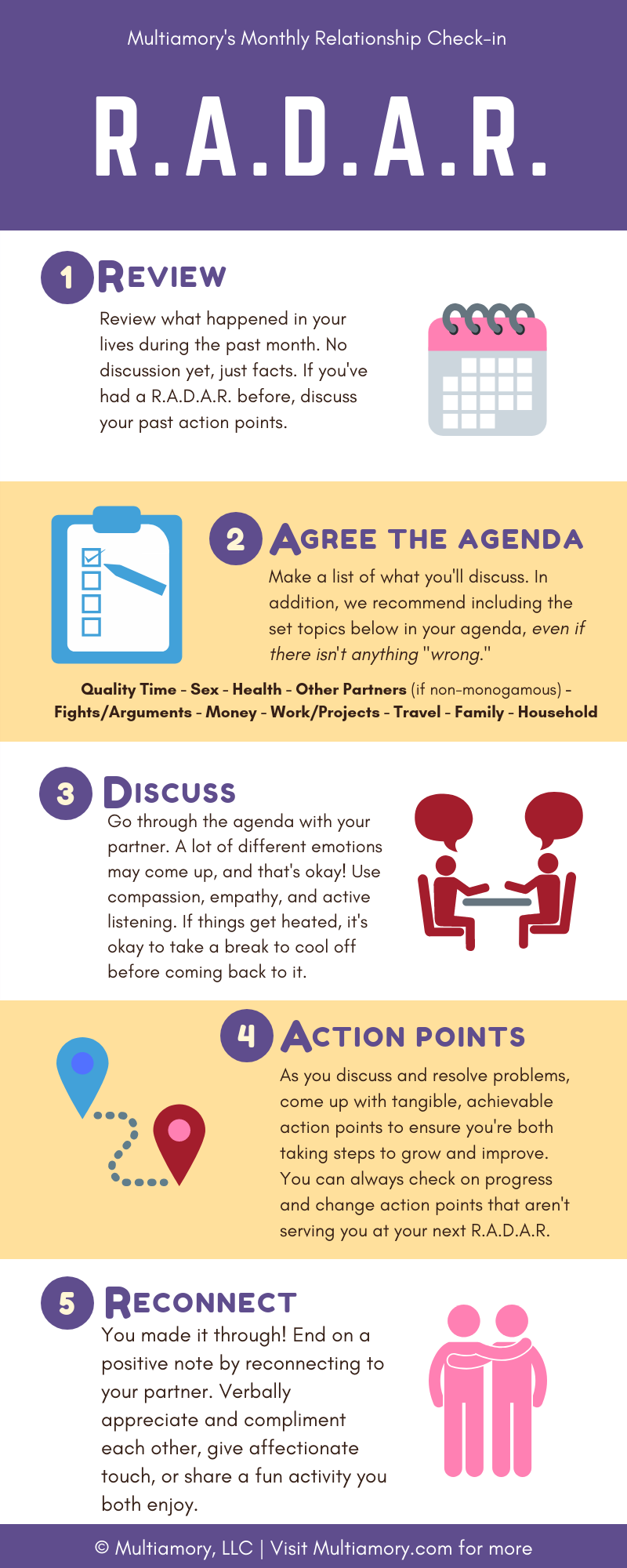
For some this takes work and practice. The more you do it, the better they become. RADARs done weekly can help with this practice. Plus, doing them weekly makes these types of conversations easier because many RADARs will be without issues. When one does come up, you are already familiar with the process and it feels less like a personal failure that you are having the conversations to begin with.
 
Hello Faerie Targaryen,

I think the key thing to keep in mind here, is, the fewer distractions, the better. The best setting for discussing an item of contention, is when everyone in the discussion is comfortable and can devote their full attention to the matter at hand. Also you want to limit how long the discussion will last, perhaps an hour or half an hour. If the matter being discussed isn't resolved in that time frame, you schedule another time to continue the discussion. This way the participants don't get burned out.

Such are my thoughts,
Kevin T.
 
Get on to the "actions" requests, and then you aren't getting dinged any more? So that solves the feelings in the long run and you get to skip this side-quest thing?
I think I understand this on a conceptual level, but I'm not exactly sure how to implement. Perhaps give an example? I'm not sure how to get around to ‘I would like if you/we do/did xyz’ without instantly indicating that something is, at the very least, askew in the relationship. Or am I conflating conflict resolution with something else? I also see him picking up on such action requests as a ‘you’re not doing well/enough’ anyway, in my experience.

Well, what do you say exactly? What words do you use? And how does he hear them exactly? Is there a gap between the two?
The most recent instance I can give is when he met someone new. The circumstances surrounding their meeting were already a little hard for me (and he would indeed later say something along the lines of ‘Well, I asked you to come to event [where he met her] as my date, and you said no). I’m trying to go into the details, but I guess I still feel sensitive about it, but this much I can say.

The arguments were mostly about him texting her during time that we were watching anime together, and him getting so distracted from the plot was very noticeable, because it was his favourite anime, and he wasn't pointing out all the exciting parts like he normally does. And when I did mention something, there was either an unenthusiastic response or straight up ‘huh?’ as he quickly looked up from his phone screen and tried to swipe the chat screen away. But I’d have already caught the purple Instagram chat boxes on screen, because we were sitting close enough for me to see what was in his hand when I simply looked his way. This was very distressing for me, because we had in fact set a boundary surrounding using phones at all while watching stuff together, especially that anime.

I tried to point out that this was going on and that frankly, him quickly trying to swipe the chat away felt like he was being sneaky in multiple ways. He later explained that he was simply embarrassed in those moments, rather than trying to be sneaky — which I can believe, because he’s a pretty honest person, almost to a fault.

Anyway, we’ve been open all our relationship, and he’d seen a few other people along the line that he never needed to text during anime time or even any time we were actively doing things together. He particularly likes to pride himself on being immersed in his experience. So, this particular NRE being so overwhelming that he couldn't help himself was a little off-putting and did make me feel jealous, among other things.

Now that I’m recounting, I do remember putting the claim of my feelings aside and going to him with the information of what I thought (that we had an agreement to be immersed in each other and whatever we were doing in the moment), rather than how I felt. And his response was something like ‘Are you sure you’re not just jealous?’ amongst other things. I did reply in the affirmative to that as well, and I don't remember his exact words, but the conversation seemed to revolve around how I wasn't simply having compersion and was accusing him of MAKING me feel jealous, and he didn't like the feeling of being accused.

The conversation(s) definitely has more intricacies, but that's a fair summary, I’d say, for the sake of brevity.

"Would you please repeat what I just said in your own words, so I know you got it how I meant it?"
I saw this in some other resource. I will definitely look into applying it now.

How does he help get the conversation back on track? What are his suggestions? Is it all on you?
Using the same recent instance, he did take back the compersion thing pretty fast. I think that blurt made him a little aware of how defensive he was being, so we took a break and came back to the part about how we had been operating on an agreement not to use our phones like that during TV time. We reviewed this particular agreement so it wasn't so set in stone. But in hindsight, that didn't really do anything — I wasn't reminding him of the agreement because I wanted to text during anime time, but I guessed conflicts don't have to be resolved in any specific way, so that was alright. However, he also didn't text her as much anymore, so the review felt a little… pointless? In fact, we had to come back to a conversation about using phones, because he confessed that he’d been embarrassed ever since, and felt like he’d already made me so uncomfortable, so he hadn't been feeling good about texting at all when I was around.

In all, I wouldn't say getting the conversation back on track is all on me. I guess I just think if I bring stuff up better, there’d be less ‘getting back on track’ altogether, and fewer feelings of being accused.

I'm not a fan of trying to do all things at once with one tool.
Fair.

Thank you.
 
Other options that have been helpful with partners. Talk while taking a walk. The left right (bilateral stimulation) of walking helps process feelings faster and you aren't looking at each other which helps keep the focus on the topic rather than the feelings coming up which can be seen on faces. This avoiding looking at each other can be done sitting back to back or similar but adding walking really helps.

Maybe agree ahead of time, separate occasion, that any time things need to be discussed that each party understand it's not about the people involved, it's about the issue. It's not you against them, it's the both of you against the problem. And to always assume your partner is coming from a place of love and not blame. If someone starts going off track, the other reminds them of this and guides them to focus on the issue and not their feelings. It's okay to feel the feelings but try to stay focused on the problem at hand.

For some this takes work and practice. The more you do it, the better they become. RADARs done weekly can help with this practice. Plus, doing them weekly makes these types of conversations easier because many RADARs will be without issues. When one does come up you are already familiar with the process and it feels less like a personal failure that you are having the conversations to begin with.
Looking forward to trying out these suggestions. Thank you, Bobbi!
 
Hello Faerie Targaryen,

I think the key thing to keep in mind here, is, the fewer distractions, the better. The best setting for discussing an item of contention, is when everyone in the discussion is comfortable and can devote their full attention to the matter at hand. Also you want to limit how long the discussion will last, perhaps an hour or half an hour. If the matter being discussed isn't resolved in that time frame, you schedule another time to continue the discussion. This way the participants don't get burned out.

Such are my thoughts,
Kevin T.
I hadn't really considered these. Thank you, Kevin!
 
However, he also didn't text her as much anymore, so the review felt a little…pointless?

It doesn't seem pointless to me. It sounds like you two needed to be clear about the difference between "in house dates" to watch TV together, in which both are expected to be PRESENT and put other distractions away, and just "hanging out at home" times where you are NOT having an in house date, you both just happen to be home. The expectation then is that people can do whatever, including play with their phones and text other people.

I'm not sure how to get around to ‘I would like if you/we do/did xyz’ without instantly indicating that something is, at the very least, askew in the relationship. Or am I conflating conflict resolution with something else? I also see him picking up on such action requests as a ‘you’re not doing well/enough’ anyway.

You just make the request. "I would like it if we do XYZ this weekend. Are you up for it?"

Not being rude... but does everything HAVE to be a big deal, a high level issue? Can't it sometimes just be run-of-the-mill life?

"Would you be willing to turn down the volume or use headphones? My head hurts." That doesn't mean anything is wrong with the relationship, or that he's not doing well enough in it. It's just that you have a headache today. No big thing, right?

I could be wrong in my impression, but it almost sounds like you are sensitive and he is sensitive. Then you both end up tripping over each other, being SO CAREFUL not to cause offense, whereas if you were more chill about it and didn't worry about it so much, some of extra stuff could be skipped.

Like with the TV thing... if I was wanting to watch together and he's all up in his phone, I'd just ask. "Are we still on for the in-house date to watch The Show at 9 PM? Do you need a minute, or to have a later start? Or should we just reschedule for another day?"

People who are used to being passive think others being assertive is AGGRESSIVE, when really it's just ordinary-life assertive. Is some of that happening here?

Are you bumping into "guess culture" vs "ask culture" stuff here? People who are used to guessing sometimes feel a direct ask is pushy or putting them on the spot too much.

GG
 
Last edited:
do remember putting the claim of my feelings aside and going to him with the information of what I thought (that we had agreement to be immersed in each other and whatever we were doing in the moment) rather than how I felt. And his response was something like ‘Are you sure you’re not just jealous?’
That is called switch tracking when someone tries to change the subject to derail the original conversation. A good way to navigate is to acknowledge they have a topic they would like to discuss and you'll address their topic after your topic is resolved. A good reply is "please stick to the subject at hand" restate the issue.
the conversation seemed to revolve around how I wasn't simply having compersion and was accusing him of MAKING me feel jealous, and he didn't like the feeling of being accused.
Because you let him take the conversation where he wanted, to flip it on you so he never had to deal with the issue at hand.
We reviewed this particular agreement so it wasn't so set in stone. But in hindsight, that didn't really do anything — I wasn't reminding him of the agreement because I wanted to text during anime time, but I guessed conflicts don't have to be resolved in any specific way so that was alright.
But is this what you wanted? A less strict rule? Were you more upset that he broke the rule or a that he was distracted by someone else during your quality time? If it's the latter, I'd want to reinforce that rule with a boundary.

If you engage in communication with others during our quality time, that's not an emergency, I will leave and our time will be over. Repeated incidences will result in the ending of our relationship.

If he cannot respect you enough to have quality time with you then you shouldn't be together. Also define quality time as not all time together is quality. Sometimes you are with friends or at a party. Scheduled dates are different than unscheduled hangs. You decide between the two of you.
 
Back
Top